Every piece I sell is hand-crafted in Europe. That’s partly about values: I want to help European makers succeed and put quality, made-to-last products in front of people who’d rather pay for something that lasts than replace a cheaper, poorer-quality alternative. It’s also practical: staying within Europe means one shipping zone and one set of tax rules to figure out, rather than a different set for every country I might otherwise source from. I left my corporate job in August 2025 to build this business, and it’s been exhilarating, terrifying, and eye-opening in roughly equal measure.
I’m writing this a couple of months in, before I’ve sold a single product. Here’s what I’ve learned so far.
The Emotional Cycle of Change: More Than a Buzzword
We all love the idea of transformation, but the reality is messier. Here’s how the “Emotional Cycle of Change” has played out for me so far:
- Uninformed Optimism: The honeymoon phase - and honestly, that’s where I am right now. Everything seems possible. I’m full of ideas and energy, riding the initial wave of excitement.
- Informed Pessimism: Reality sets in. The to-do list grows, and doubts creep in. Am I really cut out for this?
- Valley of Despair: The hardest part. Progress feels slow, and quitting seems tempting. This is where most people give up.
- Informed Optimism: Small wins start to appear. I will need to learn from mistakes and see a path forward.
- Success: Not there yet - but I now know it’s a process, not a moment.
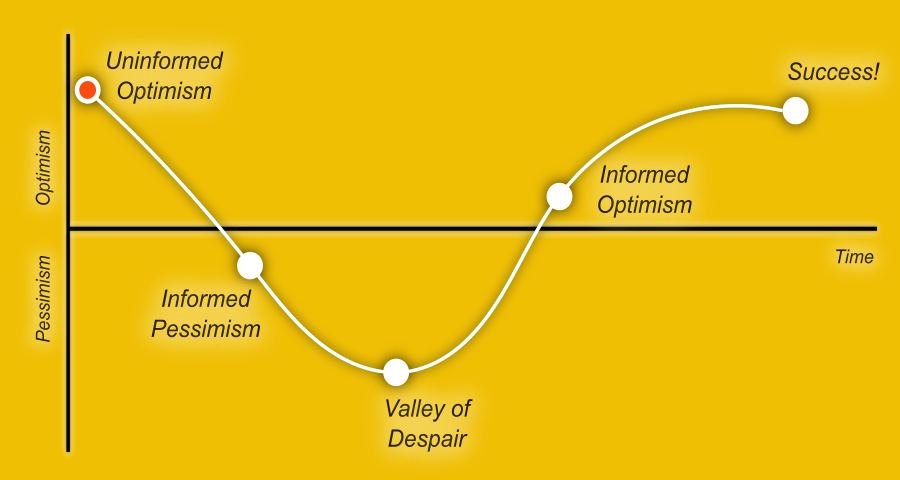
If you’re in the Valley of Despair, you’re not failing - you’re learning. That’s where growth happens.
Source: Emotional Cycle of Change by Don Kelley and Daryl Conner, published in “The 1979 Annual Handbook For Group Facilitators.” Some sources give the original name for the third stage as “Hopeful Realism” rather than “Valley of Despair” - the latter is the more common popular label.
The 5 Fundamentals: What Actually Matters
There’s endless advice out there, but Josh Kaufman’s five fundamentals are the framework I keep coming back to. I’m still early enough that most of this is thinking rather than proof - I’ll find out what actually works as I go.
1. Value Creation: What real problem am I solving? For me, it’s helping people find products that align with their values, not just their needs.
2. Marketing: How will people discover me? My working assumption is that authentic storytelling and community engagement will beat big ad budgets, especially early on - but that’s untested so far.
3. Sales: Turning interest into revenue is harder than it looks, and I haven’t done either yet. I’m weighing direct outreach against partnerships with the crafters themselves, but what will actually work is for the future to tell.
4. Value Delivery: Can I consistently deliver what I promise? I’m still building the systems for this - it’s one of the pieces I understand least well right now.
5. Finance: Track every Euro. It’s the one fundamental I can already act on, even before there’s revenue to track.
Source: 5 Parts of Every Business by Josh Kaufman, from his book “The Personal MBA”
My Hard-Won Lesson
The biggest trap so far has been procrastination dressed up as productivity. Spreadsheets, a pitch deck, the company logo - all things I could finish in a day or two. Easy, compared to the actual hard task: learning how to build a profitable business and facing the fear of failing at it. I haven’t sold a single product yet, and I know nothing will teach me more than talking to real customers and shipping real products, even imperfectly, when the time comes.
If there’s one habit I’m trying to build, it’s this: make the hard decision now, so the decisions later get easier. If entrepreneurship is something you want to learn and do, don’t put yourself in the position of regretting that you never tried.
What About You?
Have you made a big leap, or are you thinking about it? What’s holding you back - or pushing you forward? I’d love to hear your story - connect with me on LinkedIn, or just check back here for more honest lessons from the front lines of entrepreneurship.